Standard Operating Procedure for Industrial Water Tank Cleaning: Compliance Guide

Master the standard operating procedure for industrial water tank cleaning. Essential guide for safety, compliance, and water quality protocols.
Standard Operating Procedure for Industrial Water Tank Cleaning: A Compliance Guide
Let’s be completely honest for a moment. When you are operating in an industrial or large-scale commercial capacity, your water infrastructure is not just a storage vessel—it is a critical asset that demands rigorous oversight. You aren’t just dealing with a plastic tank in a residential backyard; you are managing massive reservoirs, steel-lined storage, or concrete basins that feed an entire facility.
But here is the real talk about water safety: when you are dealing with industrial-scale systems, the margin for error is razor-thin. A contaminated tank doesn’t just result in a “bad taste”—it can lead to facility-wide production shutdowns, non-compliance with federal health mandates, and severe legal liability if your water supply becomes a vector for pathogens.
Look, I get it, navigating the complex OSHA, EPA, and AWWA requirements is exhausting. You are faced with a dense forest of regulations, confined space entry permits, and chemical balancing acts that can make your head spin. But you don’t need to hire expensive outside consultants for every single maintenance cycle if you understand the core mechanics of the work. Here at TankClean.site, we specialize in demystifying these processes, providing the authoritative guides, maintenance tips, and water hygiene protocols that facility managers actually need.
If you are a maintenance lead, property manager, or facility operator, you need a rigid, bulletproof standard operating procedure for industrial water tank cleaning. This article breaks down the professional workflow, safety requirements, and technical steps required to keep your system clean, safe, and fully compliant with national standards.
Why a Documented SOP is Non-Negotiable
In the industrial world, if it isn’t documented, it didn’t happen. An SOP (Standard Operating Procedure) serves two vital roles. First, it ensures that every single member of your maintenance team performs the task exactly the same way, every single time, minimizing human error. Second, it serves as your primary defense during regulatory audits.
When OSHA inspectors or municipal health authorities come knocking, they don’t want to hear that you “usually clean the tank around this time of year.” They want to see the signed permits, the chemical logs, and the documented proof that you followed an industry-recognized standard. Without an SOP, you are leaving your facility wide open to fines and operational risks.
Pre-Cleaning Assessment Checklist
Before your crew even approaches the tank, you need a rigorous pre-cleaning assessment. You cannot just dive into an industrial reservoir. You must treat it as a high-risk operational environment.
| Checklist Item | Purpose | Frequency |
| Confined Space Permit | Ensures OSHA compliance for entry safety | Mandatory per entry |
| Atmospheric Monitoring | Tests for H2S, CO, and oxygen levels | Before & during entry |
| System Isolation | Prevents water backflow and electrical hazards | Before drainage |
| Structural Inspection | Checks for rust, liner tears, or concrete spalling | Every cleaning cycle |
| De-chlorination Plan | Ensures environmental safety for water discharge | Every cleaning cycle |
The Science of Sanitization: Choosing Your Method
Not all sanitizers are created equal. In an industrial setting, you are often limited by the type of tank material you have. Using the wrong agent can void your warranty, degrade your liner, or leave toxic residues. Here is how the most common industrial sanitization methods compare.
Chlorine (Sodium Hypochlorite): The industry gold standard for AWWA C652 compliance. It is effective, relatively cheap, and easy to monitor. However, it requires careful handling and specialized de-chlorination measures before the wash water is discharged into public sewers.
Hydrogen Peroxide: Often used for more “natural” or specialty applications. It is effective against a broad spectrum of pathogens but is more volatile and requires careful storage. It is excellent if you have plastic linings that might be sensitive to high chlorine concentrations.
Ozone Treatment: A cutting-edge, chemical-free method. It is incredibly potent, but the equipment required is specialized, expensive, and generally only accessible to high-end professional cleaning contractors. For most industrial facilities, chlorine remains the backbone of the standard operating procedure for industrial water tank cleaning.
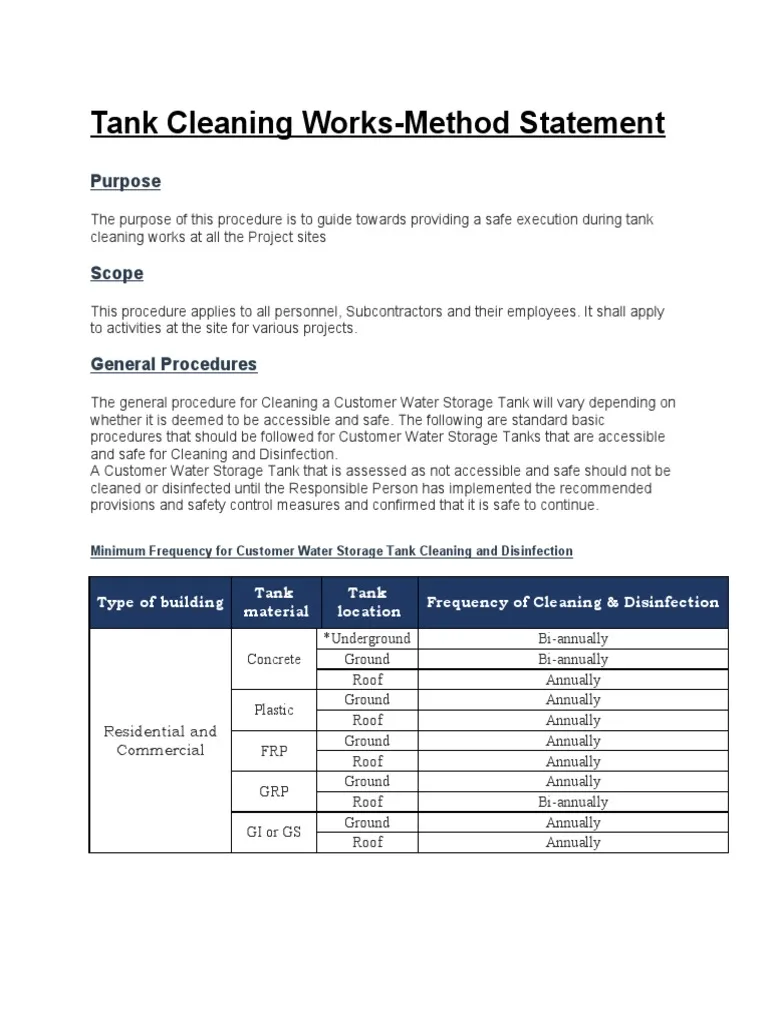
The Step-by-Step Cleaning Procedure
When you are ready to procced with the maintenance, follow these steps with absolute precision. This procedure assumes the use of standardized AWWA practices for chlorination and physical cleaning.
Step 1: System Isolation and Lockout/Tagout (LOTO)
The most dangerous thing you can do is start cleaning while the system is under pressure. You must physically isolate the tank. Close the primary inlet valve and the main distribution outlets. Apply your LOTO tags to these valves so that no one accidentally opens them while your team is inside. This prevents any risk of pressure surges or unexpected water flow that could trap or injure workers.
Step 2: Draining and Sludge Extraction
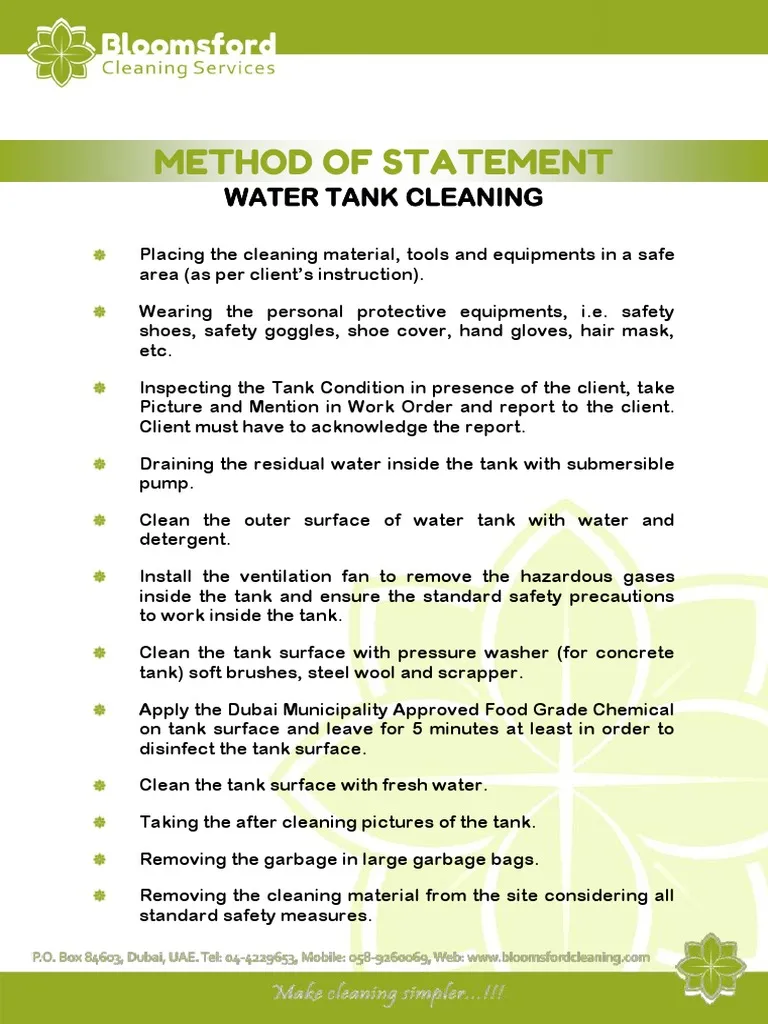
Once the system is isolated, drain the water until only the heavy sludge layer at the bottom remains. In industrial tanks, this sludge is rarely just “dirt.” It is often a cocktail of biological biofilm, rust, pipe scale, and sediment. Use a high-capacity submersible pump to remove the bulk liquid. When you reach the thick sediment, you will need to utilize industrial wet-dry vacuums or manual scraping. Do not flush this material down the facility’s internal drainage system, as it can cause massive downstream blockages in your pipes.
Step 3: Mechanical Cleaning and Inspection
This is where the physical work happens. Using a commercial-grade high-pressure washer, strip the interior walls, support columns, and floors. In industrial tanks, you aren’t just looking for dirt; you are looking for structural integrity. Check the walls for signs of pitting, rust, or coating failure. If your liner is failing, cleaning it won’t fix the underlying problem, and you might need to schedule a coating repair.
Step 4: Disinfection and Chemicales Treatment
Once the surfaces are visibly clean, apply your sanitizing solution. Whether you are spraying a chlorine mix or using a specialized wash, ensure full coverage. Every square inch of the interior must be coated. If you miss a spot, you are leaving a “seed” for bacteria to recolonize the tank immediately after you put it back into service. Use your PPE rigorously here; the chemicales used in industrial sanitization are far more concentrated than household agents and can cause severe respiratory irritation.
Step 5: The Flushing and Certification Phase
After the contact time for your disinfectant has elapsed (usually 30 to 60 minutes), you must rinse the tank thoroughly. This is the step most facilities rush, but you cannot skip it. Any residual chlorine that exceeds EPA drinking water standards can be harmful. Rinse the walls and floor, then pump out the rinse water. Once clear, fill the tank with fresh potable water.
Before you reconnect the tank to the facility, perform water quality testing. You need a certificate from an accredited lab showing zero coliform bacteria and acceptable turbidity levels. This is your final “green light” to return the system to service.
The Importance of Maintenance Logs
If you ignore the logs, their will be consequences during an audit. Maintenance is not just about the cleaning; it is about the story you tell with your records.
Every time you perform this standard operating procedure for industrial water tank cleaning, you must create a “Maintenance Dossier.” This should include:
- The date and time of the cleaning.
- The names of the certified technicians who performed the work.
- The specific chemicals and concentrations used.
- The atmospheric test results from the confined space entry permit.
- The final lab report from the post-cleaning water sample.
At TankClean.site, we always emphasize that an organized regulatory logbook is your best defense against operational liability. It shows local health departments that you take your facility’s water safety seriously and have a proactive asset management strategy in place.
Why Standardization is the Key to Longevity
Cleaning your industrial water tanks isn’t just a chore to check off a list—it is the primary method of extending the service life of your infrastructure. Corrosion, biofilm accumulation, and mineral scaling are the silent killers of water tanks. By adhering to a strict, documented, and professional standard operating procedure for industrial water tank cleaning, you can literally double the operational lifespan of your tank liners and internal plumbing assets.
Don’t leave your facility’s operational safety or your compliance status to chance. Proper maintenance is an investment in your company’s long-term operational health.
Want to ensure your facility remains audit-ready throughout the year? Head over to TankClean.site now to download our Industrial Water Tank Compliance Audit Pack. This toolkit includes standardized confined space entry templates, chemical dilution calculators, and industry-grade maintenance tracking logs that you can customize for your specific facility.
While you are there, subscribe to our industrial maintenance newsletter to receive quarterly updates on water safety standards, regulatory changes, and advanced cleaning strategies. Explore our site today for more expert resources on managing your water infrastructure with the precision and professionalism it deserves!