Commercial Water Tank Cleaning Regulations and Standards: Compliance Guide

Master the essential commercial water tank cleaning regulations and standards. Stay compliant with OSHA, EPA, and AWWA guidelines for water safety.
Commercial Water Tank Cleaning Regulations and Standards: The Ultimate Guide to Compliance
Let’s be completely honest for a moment. Managing a commercial facility comes with a mountain of paperwork, but there is one critical area you can never afford to ignore: water safety. Whether you manage a massive manufacturing facility, a multi-story office building, an apartment complex, or a hospital, your water storage system is a ticking liability if neglected.
But here is the real talk about water safety: unlike small residential setups where a quick rinse might suffice, large-scale systems are bound by a complex web of legal frameworks. Ignoring commercial water tank cleaning regulations and standards isn’t just a bad maintenance habit; it can land your business in hot water with massive regulatory fines, operational shutdowns, or even legal lawsuits if people get sick.
Look, I get it, trying to decode federal and local water mandates is exhausting. You are faced with a confusing alphabet soup of acronyms—EPA, OSHA, AWWA, NSF—and figuring out what actually applies to your specific setup can make your head spin. But you don’t need to spend thousands on compliance consultants just to understand the baseline rules. Here at TankClean.site, we break down the complex world of industrial water hygiene into straightforward, actionable insights so you can keep your facility running safely, legally, and smoothly.
Let’s dive into the core regulatory frameworks that dictate how, when, and by what standards your commercial water infrastructure must be maintained.
The Pillars of Commercial Water Quality Regulations
When it comes to commercial and industrial water storage, multiple regulatory bodies share oversight. Each organization focuses on a different aspect of the asset lifecycle—from structural integrity and material safety to workplace execution and water sanitation.
1. EPA (Environmental Protection Agency) Mandates
Under the Safe Drinking Water Act (SDWA), the EPA sets national standards for drinking water quality. If your commercial facility serves as a public water system (PWS)—which often applies to schools, large factories, and commercial parks that draw from their own wells—you must maintain residual disinfectant levels. If coliform bacteria or heavy sediment is observed, the EPA mandates immediate isolation, cleaning, and chemicales treatment.
2. AWWA (American Water Works Association) Standards
While the EPA provides the legal laws, the AWWA provides the technical execution blueprints. The gold standard for commercial tank maintenance is AWWA Standard C652 (Disinfection of Water-Storage Facilities). This standard outlines the exact chlorine concentrations, contact times, and testing protocols required to certify a storage tank safe for return-to-service. Additionally, AWWA D101 dictates how structural and coating inspections must be performed.
3. OSHA (Occupational Safety and Health Administration) Requirements
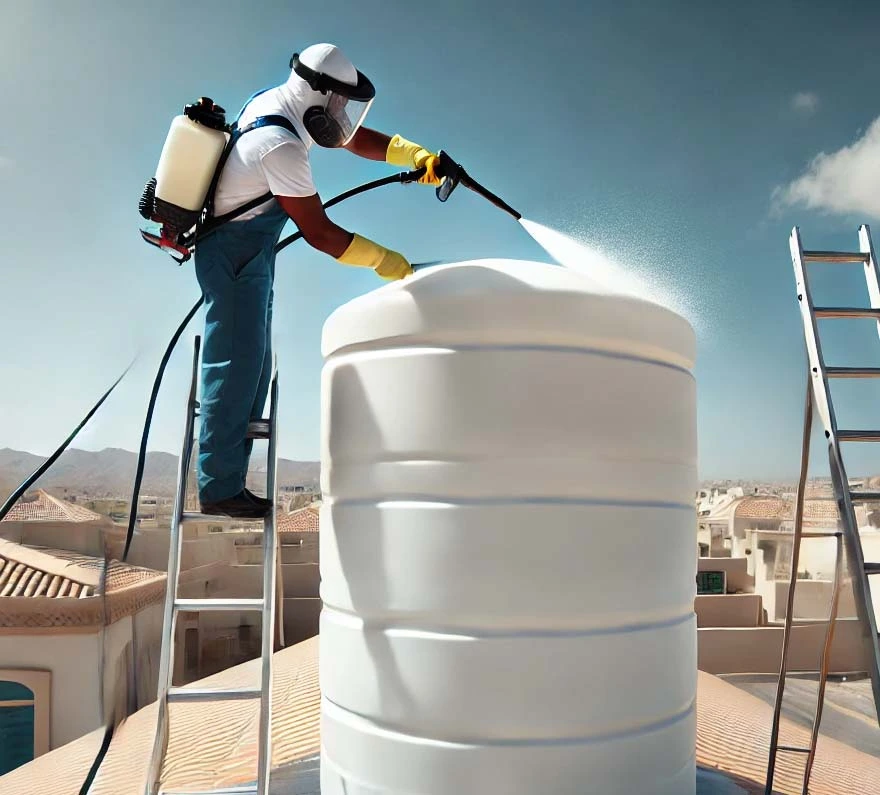
You can have the cleanest water in the world, but if your maintenance crew isn’t safe, your facility is violating federal law. Commercial water tanks are classified by OSHA as Permit-Required Confined Spaces (PRCS) under 29 CFR 1910.146. This means any worker entering the tank must have atmospheric monitoring, active ventilation, a full-body harness attached to a mechanical retrieval system, and an active entry supervisor monitoring the perimeter.
Core Compliance: Framework Comparison
To help your facility operations team cross-reference these demands quickly, here is a breakdown of how the major guidelines intersect during a standard commercial tank maintenance cycle.
| Regulatory Body / Standard | Primary Compliance Focus | Core Mandatory Requirement | Typical Frequency Trigger |
| EPA Safe Drinking Water Act | Public Health & Potability | Maintain free chlorine residuals; zero coliform detection. | Continuous tracking; clean immediately upon contamination event. |
| AWWA C652-19 | Technical Disinfection | Standardized chlorination methods (e.g., 10 ppm for 24 hours or 200 ppm spray). | Every 3 to 5 years routinely, or after any structural repair work. |
| OSHA 29 CFR 1910.146 | Worker Safety & Life Protection | Air quality testing, continuous ventilation, and a rescue plan. | Mandatory before any physical entry into the asset. |
| NSF / ANSI Standard 61 | Material Integrity | All interior chemical liners, sealants, and coatings must be non-leaching. | Verified during construction, rehabilitation, or coating touch-ups. |
Step-by-Step Commercial Tank Disinfection Protocol (AWWA C652 Method 1)
While residential guides focus on basic scrubbing, true commercial maintenance must follow strict standard operating procedures. The most common regulatory method for certifying a tank clean is the AWWA C652 Chlorination Method 1. Here is the step-by-step process your maintenance team or contracted professionals must follow.
Step 1: System Isolation and Pre-Cleaning Assessment
Before any chemical treatment begins, the tank must be completely isolated from the building’s distribution network. Close all output valves to ensure highly chlorinated water cannot accidentally flow to consumer taps. Log the initial water level, note any structural defects, and verify that the emergency drain lines are clear.
Step 2: Sludge Removal and Physical Cleaning
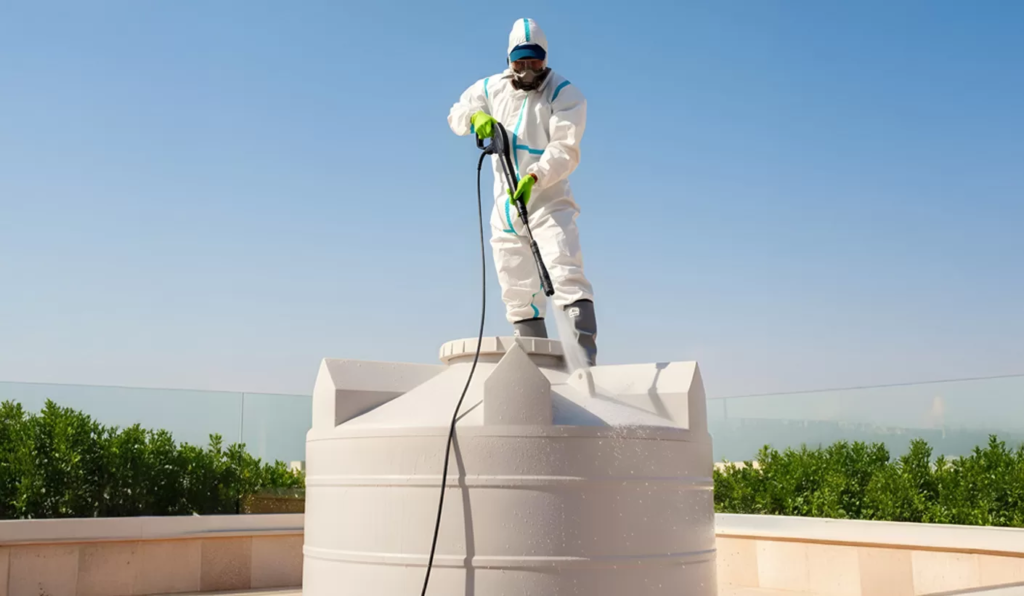
Drain the remaining water down to the sediment line. Using specialized heavy-duty pressure washers, clean the interior walls, columns, and floor to dislodge the biofilm layer where pathogens grow.
Critical Safety Rule: Air quality testing must be logged before entry. Ensure toxic gases like hydrogen sulfide haven’t built up from decaying organic sludge.
All dislodged mud and debris must be pumped out of the tank using specialized wet-dry extraction gear. Do not flush this down the facility’s internal drainage system, as industrial sludge can cause severe blocks.
Step 3: Preparing the Disinfection Solution
According to AWWA guidelines, prepare a solution that will yield a free chlorine residual of 10 parts per million (ppm) when the tank is filled to its maximum capacity. Typically, concentrated sodium hypochlorite is calculated against total tank volume to achieve this precise ratio.
Step 4: The 24-Hour Retention Period
Fill the tank to its overflow level with the chlorinated water mixture. Let the solution stand for a minimum of 24 hours. During this period, the high concentration of chlorine breaks down any remaining bacteria spores and microscopic organic matter on a cellular level.
Step 5: De-chlorination and Environmental Discharge
You cannot simply dump thousands of gallons of heavily chlorinated water into municipal storm drains—doing so violates environmental laws and can result in severe fines. The water must pass through a specialized de-chlorination manifold using neutralizing chemicals like sodium thiosulfate until the residual levels drop below local regulatory environmental limits.
Step 6: Post-Cleaning Water Quality Testing
Once the tank is emptied of the cleaning solution, refill it with fresh, potable input water. Let it settle, and then pull samples from representative points. The water must be sent to a certified laboratory to check for:
- Total Coliform Bacteria (must be completely absent)
- Heterotrophic Plate Count (HPC) levels
- Turbidity and unexpected odor profiles
Once the laboratory issues a clean certificate, you can safely procced to open the main supply valves and bring the system back online.
Why Keeping Regular Maintenance Logs is Mandatory
If an auditor steps onto your property tomorrow, simply telling them “we cleaned the tank last year” won’t save you. In the industrial world, if it isn’t documented, it didn’t happen.
Every commercial facility is required to hold a comprehensive maintenance log. This file should contain detailed records of every cleaning cycle, copies of the confined space entry permits signed by your safety supervisor, lab reports verifying water purity, and inspection notes detailing the condition of the interior structural coatings.
At TankClean.site, we regularly emphasize that an organized regulatory logbook is your best defense against operational liability. It shows local health departments that you take your structural water hygiene seriously and have a proactive asset management strategy in place.
Maintain System Compliance Effortlessly
Navigating commercial water tank cleaning regulations and standards can feel like a full-time job, but breaking it down into structured, periodic intervals ensures your business stays fully compliant without unexpected downtime.
Don’t risk your facility’s operational safety or face costly regulatory fines due to overlooked paperwork. Head over to TankClean.site now to download our comprehensive, industry-grade Commercial Water Compliance Audit Pack, which includes standardized logbooks, OSHA-compliant confined space pre-check checklists, and AWWA calculation sheets.
You can also subscribe to our corporate compliance newsletter to receive automated quarterly alerts on updating regional standards, product safety changes, and facility maintenance strategies. Explore our specialized commercial resources today to keep your facility’s water crystal clear and fully legal!